
Forget Scanning Thousands of Images Classification-Only Searches Data Accuracy Gaps Slow, Cumbersome Interfaces
AI-Powered Industrial Design Search with Unparalleled Coverage


We invented a different way to work with Designs and it changes the game

Save up to 90% of your time with AI-driven Design Search

Get all what you wished for and a lot more in a single platform

Discover records not present elsewhere

Worldwide data coverage for robust Design FTOs
The Future of Design Search
Effortless Navigation for Creative Inspiration
Quickly view and analyze high-quality design images with minimal load time with a database of more than 23M+ designs. The platform ensures smooth navigation between search results for a seamless workflow.

Smart Filters for Precise Design Searches
Use smart filters powered by AI to refine your design searches based on functional, ornamental, and visual elements. These filters help ease up the process, delivering relevant results more efficiently.

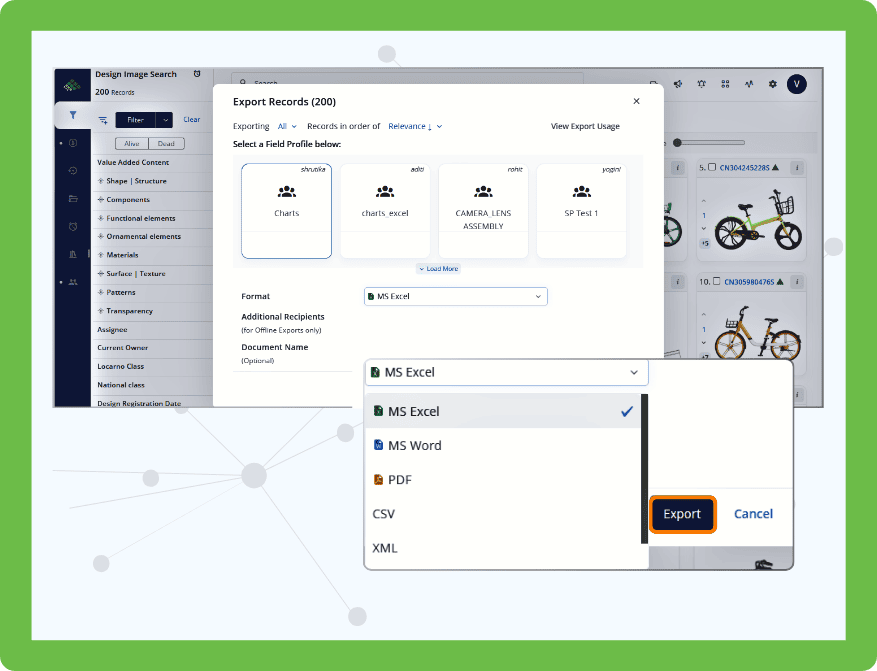
Custom Exports with Real-Time Alerts and Monitoring
Tailor your export settings to include selected records, metadata, and comments in multiple formats, such as Excel (.xlsx), RIS, and XML. Efficiently organize and share data with your team or stakeholders.
User-Friendly Interface for Easy Navigation
The interface is designed for ease of use, allowing users to navigate complex data and search results quickly. With a focus on clarity and responsiveness, tasks become more efficient and less time-consuming.

Create and Share Dashboards
Beyond singular visualisations. Prepare a set of stunning charts that convey the desired insight and share it with stakeholders.


Transforming Design Searches with Computer Vision and Image Recognition Technology

Power of Computer Vision
High Precision Image Searching
Use leading-edge image recognition technology, trained on millions of design images, to get accurate search results quickly

Value-added Content
Enriched Data with Smart Filters
Uncover a bold new way to refine and search through designs
The only Industrial Design solution your will ever need
Rapid Image Loading
Citation Searching
Translations
Similarity Searching
National Classifications
Search History
Command-line Queries
Customisable Exports

Frequently Asked Questions
What is PatSeer Design?
PatSeer Design is an AI-powered industrial design search platform especially designed for professionals to conduct design searches. It leverages advanced image recognition technology to deliver fast, accurate, and efficient searches. By offering extensive coverage from 86 authorities and enhancing search precision, PatSeer Design helps professionals identify relevant prior art and potential infringements with ease.
Who can benefit from using PatSeer Design?
Emerging markets are likely to act as early entry points for generics and biosimilars, not just secondary markets. Due to regulatory differences and manufacturing strength, countries like India and China could influence pricing, supply chains, and competitive dynamics globally, potentially accelerating pressure on branded players even before major markets open.
What features make PatSeer Design stand out?
Reactive patent monitoring means responding to patent-related developments after they have already created a problem, typically when a company discovers a competitor’s filing during litigation, a product launch review, or an FTO assessment that was triggered by an external event.
Proactive patent monitoring, by contrast, treats the patent landscape as a continuous intelligence feed. It involves setting up always-on alerts across relevant technology areas, competitor portfolios, and jurisdictions so that filings, legal status changes, and litigation activity surface as they happen. The goal is to give product, R&D, and IP teams enough lead time to make decisions, whether that means adjusting a development roadmap, initiating a licensing conversation early, or building prior art before a competitor’s application is granted.